

A Folk Hero is Born

Yesterday, the Rio Grande Presbytery of the Presbyterian Church in America indefinitely suspended pastor Zachary Garris. They did not suspend him over his comments defending American chattel slavery as biblical; he was found not guilty of that. They did not suspend him for liking multiple explicitly racist memes on social media. They did not suspend him for his work with Eric Conn and Brian Sauvé, two “independent Presbyterian” pastors who have become infamous for their racist statements and alliances. They did not suspend him for continuing to publish, and profit from, a book from one of the Reformed world’s most notorious white-nationalist “Christians,” Adi Schlebusch.
No, the PCA suspended Garris for saying mean things on the internet to another PCA elder who is known himself for saying even meaner things to people on the internet. Here are the charges that stuck, as presented by his ally, pastor Sean McGowan. There is the chance there are worse statements not shared by McGowan, but given specification one and two are not in chronological order, I find that unlikely.
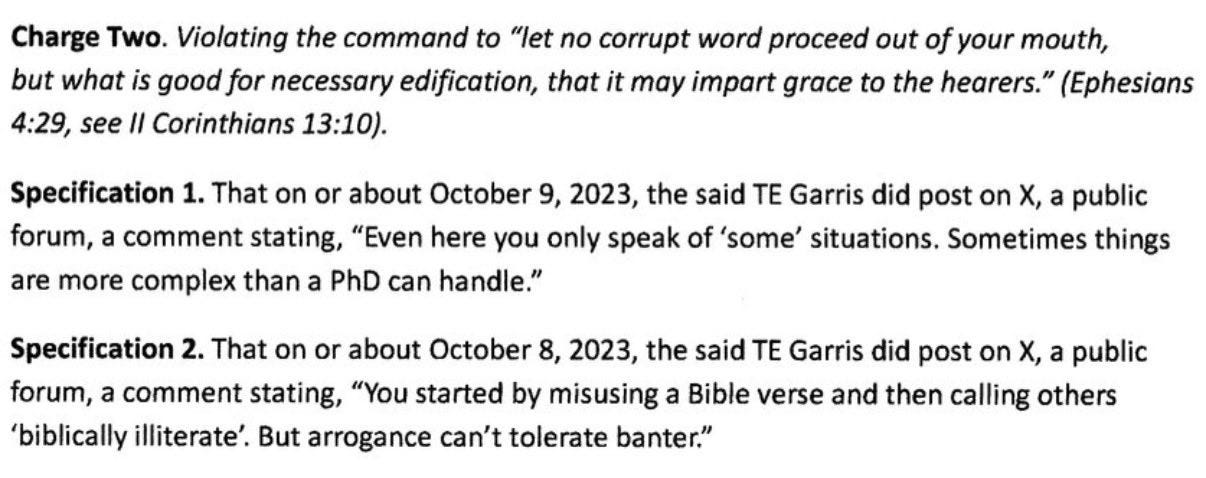
Perhaps you read these and consider them worthy of suspension; a minister should not speak like this to others, especially his peers and doubly so when the topic is racism. I agree, but, unfortunately for the legitimacy of the charge, this pales in comparison to how the person Garris wrote these two statements to, PCA theologian Anthony Bradley, writes to others himself. To show this, I will only need one example: the legitimate complaint of someone readers will know I hold no favor towards, who is herself well-known for unchristian online conduct, Daily Wire reporter Megan Basham.


We could parse the minutiae of the boundaries of acceptable online speech for Christians, but that would be beside the point. There is no question that, if Garris deserves to have his license to preach suspended solely over the above comments, then so does Bradley. The unequal weights and measures of this decision are front and center, for everyone to see; the emperor has no clothes.
The hypocrisy itself is not the worst of this decision, it’s the fallout. Young, culture-warring Presbyterian seminarians were already highly predisposed towards Christian Nationalism. As one theologian recently said to me, “All of the momentum among young Presbyterians is with Christian Nationalism.” Garris is one of the vanguards of the movement, one of the co-authors, along with McGowan and Stephen Wolfe, of a contra-report to the one expected soon from the PCA’s Christian Nationalism study committee. For the PCA to suspend Garris on a process offense, one that barely makes sense, given the context of whom he was arguing with, is the greatest of parliamentary and political blunders.
They have made Garris a folk hero to these young men.
Everybody loves an underdog, and everyone has a sense of justice written on their hearts. These young men, already buying into the white-grievance persecution complex put forth as a key component of the Christian Nationalist message, now have a concrete injustice within their denomination to point to as evidence. If the Rio Grande Presbytery had done their job and thrown a highly-evidenced, legitimate book at Garris for the years of unacceptable behavior around the subject of ethnicity he’s very publicly guilty of, it would have sent a message that these grievance politics are a sure-fire way to ruin your career as a minister. Instead, they did the very opposite and validated the core grievance narrative, that if you speak “uncomfortable truths,” you will be persecuted by the “boomers” running the denomination. The PCA, in its inability to run a professional trial, has solidified this generation’s New School and has set the stage for rebellion and schism.
I wonder if many consider how turning a blind eye to the misogyny of Spangler (ex-OPC) and Garris (PCA), published well before their opinions on race surfaced, has played into the current moment.
This is so messed up. The amount of people running to defend Garris, even claiming he's being "persecuted" is disgusting.